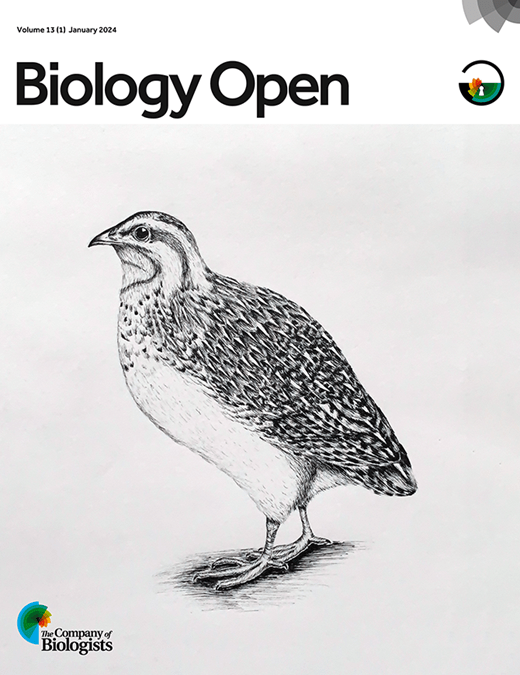
In preparation for migration, common quail accumulate fat stores and modulate their innate immune functions. They increase their immunity midway through the fattening process. Individuals that accumulate less fat maintain a higher immune response, suggesting a competitive relationship between these processes, explored in the paper by Marcin Tobolka and colleagues. Image credit: Zuzanna Zielinska. Creative Commons Attribution 4.0 International license.
During their migrations, migratory birds are exposed to numerous pathogens. A functioning immune system is therefore crucial when flying into new environments. However, immunity is energetically costly and competes with other important physiological processes. In our latest work, we examined the extent to which fattening before bird migration influences innate immunity using the common quail as our study species.
While many studies showed that the immunity of birds is often weakened during their strenuous migratory flights, it remains little understood if and how immunity changes during the rapid accumulation of energy stores in preparation for migration. To fill this knowledge gap, we induced pre-migratory fattening through controlled changes in daylight and regularly examined changes in three markers of innate immunity – leukocyte coping capacity (LCC), hemagglutination and hemolysis titers. In addition, body composition, namely lean mass and fat mass, was measured.
We found that all three markers showed similar changes during pre-migratory fattening. The LCC responses, hemagglutination and hemolysis titers were on average higher in the middle fattening phase than in the high fattening phase, here the values were similarly high as before the start of pre-migratory fattening. In the middle phase of fattening, we found that the birds that had a higher fat content had lower peak LCC values and hemolysis titers. Conversely, at this time of fattening, the birds with a higher proportion of lean mass had the highest peak LCC values. We proposed that these results could be due to competing or opposing processes between metabolic remodeling and the function of the innate immune system.
These three immune indicators are integral parts of the innate immune system, which acts quickly and effectively against a wide range of pathogens, even without prior exposure. This aspect is crucial in the context of animal migration, as the ability to respond quickly to various threats is crucial for fitness. For the future, we hope that our work will encourage further studies to obtain detailed information about the remodelling of the immune system during the most energetically demanding phases in the life cycle of migratory birds.
Our article “Controlled expression of avian pre-migratory fattening influences indices of innate immunity” by Marcin Tobolka, Zuzanna Zielińska, Leonida Fusani, Nikolaus Huber, Ivan Maggini, Gianni Pola, Valeria Marasco Biol Open 15 January 2024; 13 (1): bio060018. doi: https://doi.org/10.1242/bio.060018 is freely accessible and open access.
Project: Landfill foraging in migratory birds: pain or gain Humane pressure is threatening many organisms to the edge of extinction. However, some species may even profit from human-induced environmental changes. For example, many birds and mammals regularly forage on food waste deposited in landfills. To which extent these anthropogenic food sources can have positive or negative impacts on animals´ life-history decisions and fitness outcomes remain relatively poorly investigated. Our international team aims to tackle this question by studying migratory white storks (Ciconia ciconia) breeding in Poland where we have recently observed a remarkable increase in the use of anthropogenic food sources. The project aims to advance our understanding of the impact of anthropogenic changes on wildlife population health and fitness and contribute to biological conservation. We are seeking 3 PhD candidates to investigate the impact of anthropogenic food sources on various life-history traits of white storks. Using a comprehensive approach, integrating ecological, behavioural, and physiological measurements, the projects focus on one of three scientific subjects: How does parental foraging on landfills modulate 1) survival and fitness, 2) foraging and migration behaviour of juveniles, and 3) how these relate to metabolic and physiological changes during early life. Each PhD is individually supervised by a Project Supervisor from the hosting institution, who will concentrate their training on an individual research project (training-by-research) within one of the three main research subjects.
Project 1 will be based at the Department of Zoology, Poznań University of Life Sciences (PULS) in Poland. It will explore the impact of landfill foraging on breeding outcome, growth, and survival. Project 2 will be based at the Max Planck Institute of Animal Behavior (MPI-AB) in Konstanz, Germany. The project will examine how foraging in landfills affects migratory decisions. Project 3 will be based at the Research Institute of Wildlife Ecology (FIWI), Department of Interdisciplinary Life Sciences at the University of Veterinary Medicine Vienna (Vetmeduni) in Austria. The project will examine the impact of landfill foraging on the physiology and metabolic status of individuals.
Detailed descriptions of the three projects are below. This is a highly collaborative, internationally-based work. We are looking for passionate and motivated researchers who are strongly committed to the research. Regular, mutual interactions and exchanges across the PhD candidates and partner institutions are envisioned and wanted. These will ensure that all candidates will be involved in the research activities of the other projects ensuring a highly vibrant and stimulating environment for the growth and development of young re-searchers. The students will have the opportunity to work at the interface of several disciplines, spanning from ecology, eco-physiology, animal behaviour and movement ecology. Thus, good organisational and communication skills are required because the candidates must communicate well across the project partners.
Deadline for submission: 22nd January 2024. Interviews with selected best candidates: 29th January – 2nd February 2024. Preferred contracts start: 1st – 15th March 2024. Are you interested? Then we are looking forward to receiving your application until 22nd January 2024 through the applicant management system of the MPI-AB. Please include the following documents: • Curriculum Vitae (CV); • Transcript of records (record of study) and degree certificate of bachelor (BSc) degree, Vordiplom or equivalent degree; • Transcript of records (record of study) and degree certificate of Master (MSc) degree, Diplom or equivalent degree (if applicable). If your degree programme is not yet completed, please provide temporary transcripts; • Two letters of recommendation will be required, one from your previous MSc supervisors; • Letter of Motivation, specifically addressing research interests and why you would like to choose the selected project(s)/research topic. Questions about the positions will be answered by Marcin Tobółka at PULS (marcin.tobolka@up.poznan.pl) for Project 1, Andrea Flack at MPI-AB(aflack@ab.mpg.de) for Project 2 and Valeria Marasco at Vemeduni (valeria.marasco@vetmeduni.ac.at) for Project 3.
PhD position 1
Place of residence: Department of Zoology, Poznań University of Life Sciences, Poland. The candidate will be involved in fieldwork (field observations, bird handling and measuring, study system setting (trial cameras, iButton loggers, weather stations, UAVs, GPS-GPRS_ACC transmitters, tissue sampling), laboratory analyses (microbiological and immunological assays), different techniques of quantitative data analysis, and leading the writing of scientific articles and dissemination of the obtained results. The ideal candidate should be prepared to conduct re-search independently and be willing to learn and apply new skills (e.g. in programming (R) or laboratory analyses). Experience in fieldwork and basic skills for analysing spatial data are very welcome. Applicants should hold a Master’s degree (or equivalent) in biology, ecology, animal behaviour, zoology, veterinary medicine or a related subject. Our working language is English. (Polish language skills are not a requirement). Good organisational and communication skills are required because the candidate must communicate well across scientific fields and project partners.
WE ASK •Master’s or equivalent level degree in biology, ecology, veterinary medicine, animal behaviour, zoology or related field • Proficiency in written and spoken English (B2 level – the minimum) • Good organisational and communication skills are required • Driving licence (cars up to 3.5 t) is required • No fear of working at heights (up to 20 m) is required • Willingness to learn R programming languages. Prior familiarity with these or other programming languages is preferred • Basic experience in microbiological or physiological laboratory work is preferred
WE OFFER The successful candidate will join the team of Animal Ecology, Department of Zoology, Poznań University of Life Sciences. We are a young group that explores the elements that shape animal ecology and behaviour, particularly anthropogenic pressure. To do this, we use several animal models in different settings, farm-land birds, wild pollinators in rural and urban landscapes. The white stork population is one of our best study systems with very long-term data on distribution and breeding performance.
PhD position 2
Place of residence: Collective Migration group at Max Planck Institute of Animal Behavior, Konstanz, Germany. The candidate will be involved in different techniques of quantitative and statistical data analysis, leading to the publication of scientific articles. The ideal candidate should be willing to participate in fieldwork in Poland (1-2 months per year). The candidate should be prepared to conduct research independently and be willing to learn and apply new skills (e.g. in programming (R/Python) or computer vision algorithms). Experience and interest in fieldwork are very welcome. In addition, quantitative skills for analysing spatial and temporal data are required. Applicants should hold a Master’s degree (or equivalent) in ecology, animal behaviour, zoology, or a related subject. Our working language is English. Non-native speakers need to provide documentation of their English proficiency (C1level). (German language skills are not a requirement). Good organisational and communication skills are required because the candidate must communicate well across scientific fields and project partners.
WE ASK •Master’s or equivalent level degree in ecology, animal behaviour, or related field. Graduates with a 4-year Bachelor’s degree (with written thesis) in a related subject will be considered in exceptional cases •Proficiency in written and spoken English (C1 level). Non-native speakers need to provide documentation of their English proficiency (e.g. TOEFL). German proficiency is not required • Good organisational and communication skills are required •Willingness to learn R or Python programming languages. Prior familiarity with these or other programming languages is preferred • Experience in data science and statistical modelling is preferred • Driving licence (cars up to 3.5 t) is preferred
WE OFFER The successful candidate will join the Max Planck Institute of Animal Behavior and the University of Konstanz. The Flack flock is a small, young group that explores the elements that shape migratory decisions of long-distance migrants. To do this, we use state-of-the-art high-resolution biologging in combination with experimental approaches in the field. The student will join the International Max Planck Research School for Quantitative Behaviour, Ecology and Evolution (IMPRS-QBEE), a joint doctoral program between the Max Planck Institute of Animal Behavior and the University of Konstanz.
PhD position 3
Place of residence: Research Institute of Wildlife Ecology (FIWI), Department of Interdisciplinary Life Sciences at the University of Veterinary Medicine Vienna. The candidate will perform laboratory eco-physiological analyses (including metabolic hormones, oxidative stress, and telomere dynamics), statistical analyses of collected data, and will lead the writing of scientific articles. The ideal candidate should be willing to participate in fieldwork in Poland (1-2 months per year). The candidate should be prepared to conduct research independently and be willing to learn and apply new skills (e.g. in the field of cellular and organismal physiology). In addition, knowledge of ecophysiology and related laboratory skills is required. Experience and interest in fieldwork are very welcome. Applicants should hold a Master’s degree (or equivalent) in ecology or eco-physiology, animal behaviour, zoology, or a related subject. Our working language is English. German language skills are not a requirement. Good organizational and communication skills are required because the candidate must communicate well across scientific fields and project partners.
WE ASK •Master’s or equivalent level degree in ecology or eco-physiology, animal behaviour, or related field. Graduates with a 4-year Bachelor’s degree (with written thesis) in a related subject will be considered in exceptional cases • Proficiency in written and spoken English. German proficiency is not required • Experience in biological laboratory analyses in the field of ecophysiology or molecular biology are required • Experience in data science and statistical analyses are required; prior experience with R or other programming languages is very welcome • Strong organisation and record-keeping skills to store and analyse data are required; •Driving licence (cars up to 3.5 t) is preferred
WE OFFER The successful candidate will join the wildlife physiology team of the Research Institute of Wildlife Ecology (FIWI, Vetmeduni Vienna) where he/she will be based. The PhD candidate will be supervised by Valeria Marasco in collaboration with other scientists in Vienna and abroad. We are a young group that explores the physiological processes of energy metabolism underpinning animals´ life history trajectories, with an increasing focus on seasonality factors in the context of a rapidly changing world. To do this, we combine state-of-the-art methods, in molecular physiology, endocrinology and redox biology with experimental approaches in the lab and in the field.

 Physiological ecology of life histories