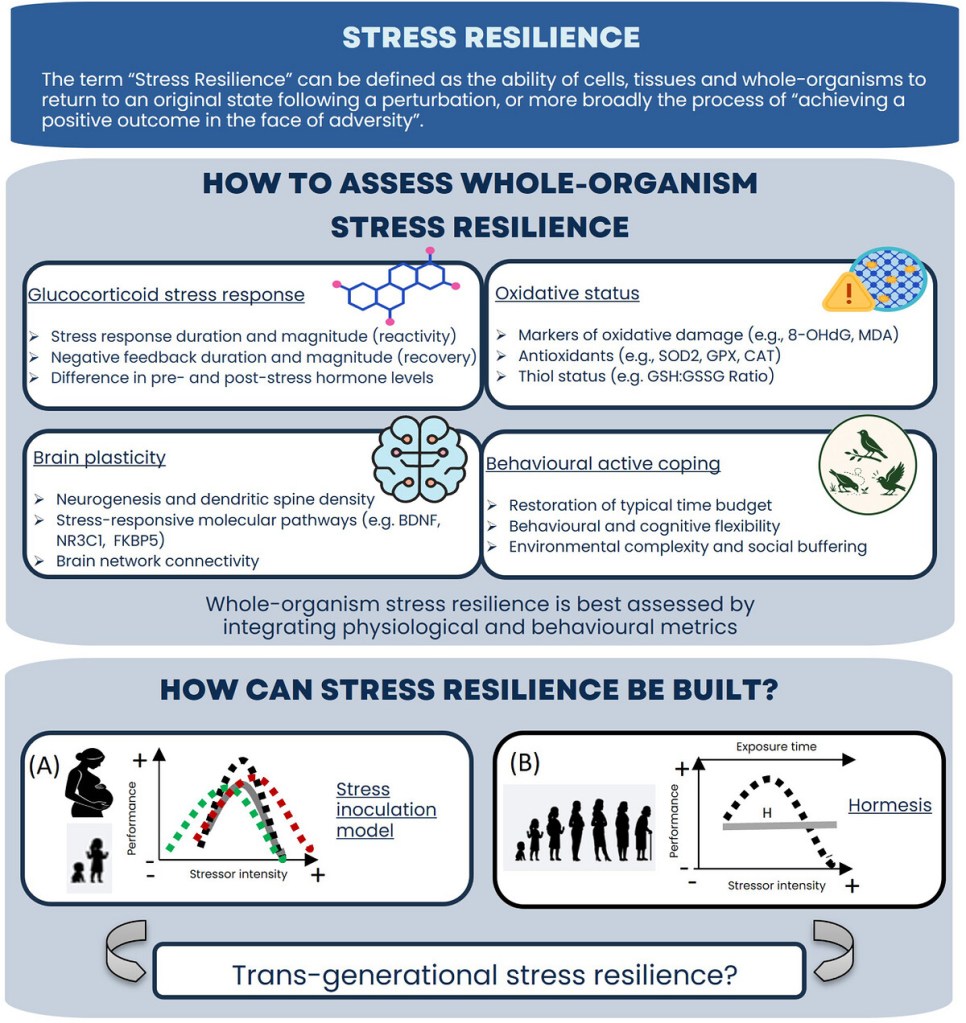
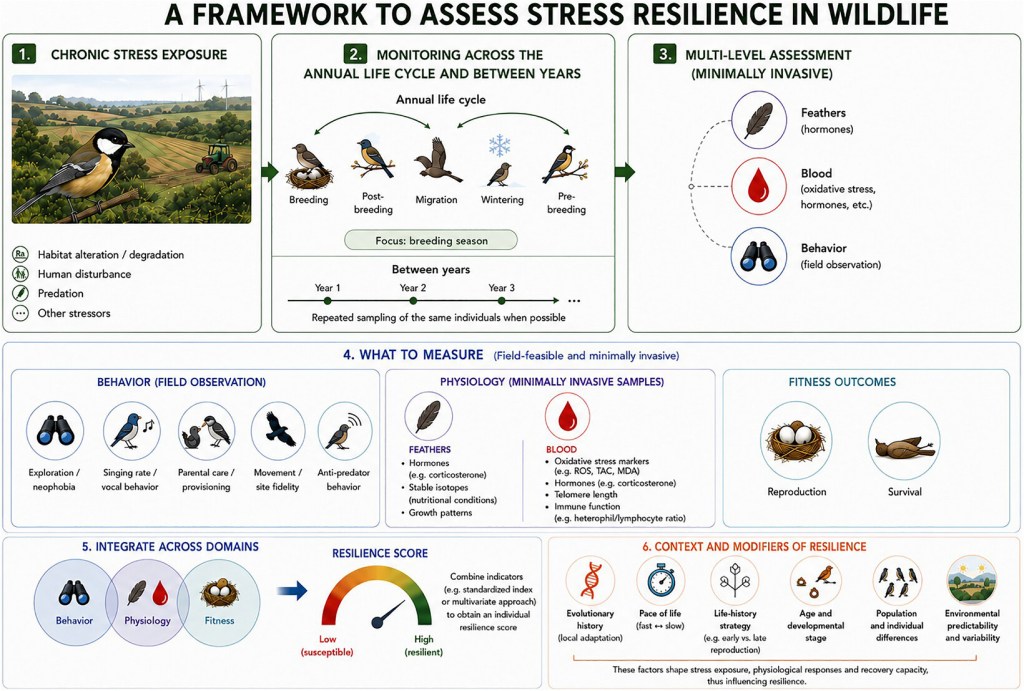
Climate change, environmental pollution and changing habitats are confronting animals with ever new challenges. Against this backdrop, research is increasingly focusing on how organisms cope with such pressures and why some are more resilient than others. In our latest OA review paper, we brought together findings from different disciplines to investigate the biological foundations of stress resilience – from hormones and oxidative stress to behaviour and neural processes. There are no doubts that stress is, first and foremost, a necessary adaptive response. In the short term, stress responses help animals cope with food scarcity, social conflict, predators or extreme weather conditions, for example. However, a stress response that is activated repeatedly or over a prolonged period is known to have adverse effects on health and fitness across many vertebrate species including humans. Animals do not respond uniformly, though. Even within a single species, the consequences of chronic stress can vary considerably. Broadly, resilience often involves either maintaining important functions during a challenge or recovering them afterwards. Under certain conditions, repeated challenges may even promote adaptive processes. Key factors include the type, intensity, frequency and duration of a stressor, as well as genetic, developmental and life-history factors. In order to measure organismal resilience to stress exposure, we propose to look at different dimensions of the stress response and recovery – including glucocorticoid regulation, oxidative status, neural processes and behaviour. This is because some functions may remain stable or recover quickly, while others may remain altered.
Natural Habitats as a Research Laboratory
We stressed that research on wild animals under ecologically relevant environmental conditions are particularly important. In the wild, animals are often exposed to several stressors at the same time and over long periods: rising temperatures may coincide with noise, artificial light at night, pollutants or changes in food availability and quality, including increased access to human-derived food resources. For example, studies in birds and reptiles show that animals living in cities may exhibit altered glucocorticoid hormone levels or attenuated stress responses without any apparent impairment of their performance. Such changes might reflect adjustments to local living conditions and do not necessarily indicate physiological dysregulation.
Can Exposure to Environmental Stressors Increase Resilience?
A key question of our review focused on the so-called stress inoculation and hormetic-like effects. These refer to the possibility that mild or moderate challenges (even if experienced repeatedly and for prolonged periods) may, under certain conditions, strengthen an organism’s ability to cope with future stressors. Early-life conditions and parental influences play an important role in shaping these effects. However, such forms of physiological “memory” may also develop during adulthood, beyond the sensitive developmental windows when physiological plasticity is thought to be greatest. Understanding the underlying mechanisms, and determining whether such effects are actually transmitted in vertebrates, is an exciting research avenues.
Wild Animals Are Key to Understanding Stress Resilience
We believe that a major challenge is now to determine how different physiological and behavioural measures of resilience relate to each other and ultimately to health and fitness outcomes. If responses across these different dimensions show consistent patterns, they could potentially be combined into an individual “resilience score”. Alternatively, resilience may be better represented as a multidimensional “resilience mosaic”, in which some traits resist disturbance, others recover, while still others remain persistently affected.
Studies of wildlife can provide crucial insights in this area thanks to the diversity of natural life histories, which offers an opportunity to identify the mechanisms, and which traits, or combinations of traits, enable vertebrates to cope with the rapid changes occurring in their environment. Importantly, because many mechanisms involved in stress responses are conserved across vertebrates, insights from wildlife are likely to provide key information to achieve a broader understanding of stress resilience across species, including humans.
The @VetmeduniVienna PR on our latest article is available both in English and German. We are much grateful to the PR team at Vetmeduni for helping us to communicate our work to broader audiences and contribute to our #OutreachMission #OpenScience.